
Lot Survey vs Boundary Survey: What Your Closing Needs
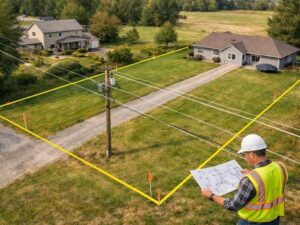
Your closing date is two weeks out. The lender asks for a survey. You call a surveyor and hear two options: a lot survey or a boundary survey. Nobody explains the difference. You pick one and hope for the best.
That’s how mistakes happen. This article breaks down both survey types, what each one covers, and how to know which one your closing actually requires.
What Is a Lot Survey
A lot survey (also called a closing survey or location survey) is a simplified drawing of a property that sits inside a recorded subdivision. It shows the lot boundaries as they appear in the recorded plat, the location of existing structures on the lot, and the distances between those structures and the property lines.
Lenders order this type of survey most often for residential closings in subdivided neighborhoods. It confirms that the house sits on the lot being sold and that no major encroachments are visible. It does not involve new measurements of the boundary corners. The surveyor works from existing plat records and field observation.
A lot survey is faster to produce and costs less than a boundary survey. For a standard residential lot in a clean subdivision, it usually meets the lender’s requirements. If the title company or lender asks for “a survey for closing,” a lot survey is almost always what they mean.
Which One Does Your Closing Need
The short answer is: ask the lender and the title company directly. They will tell you what they require. But here’s what drives that decision in most cases.
For a residential purchase in a recorded subdivision, a lot survey usually satisfies the lender’s requirements. The property has an existing plat on file, corners were set when the subdivision was created, and the lender wants a basic confirmation that the structures match the recorded lot.
Getting a boundary surveyor is typically required when:
- The property is not in a recorded subdivision
- The lot has irregular shape or unresolved gap issues with adjacent parcels
- The title commitment flags an encroachment or boundary exception
- The buyer or lender wants the corners physically located and marked
- The property includes acreage or rural land
Some lenders accept either type. Others specify one. Never assume. Get it in writing before you order.
What Happens If You Order the Wrong One
Ordering a lot survey when a boundary survey is required can delay closing. The lender rejects the survey, you have to order a new one, and you lose the time and money spent on the first.
Ordering a boundary survey when a lot survey would have worked isn’t as damaging, but you’ll pay more than you needed to. In some cases that’s still the right call, particularly if the property has any history of disputes or if you plan to build or expand after closing.
The surveyor you hire should be able to tell you which type is appropriate based on the property’s location, plat status and the lender’s requirements. If they can’t guide you on that, find one who can.
Lot Survey vs Boundary Survey: Side by Side
Lot survey:
- Used for properties in recorded subdivisions
- Based on existing plat records
- Faster turnaround, lower cost
- Meets most lender requirements for residential closings
- Does not establish or set new corner monuments
Boundary survey:
- Used for any property type, including unplatted land
- Involves physical field research and monument placement
- Takes longer, costs more
- Required for disputed lines, permits and legal proceedings
- Carries full legal authority as a boundary determination
When the Title Commitment Changes the Answer
The title commitment is worth reading before you order any survey. If the commitment lists exceptions for encroachments, overlaps or gaps, a lot survey may not be enough to satisfy the underwriter. Those exceptions signal that a boundary question exists on record. Resolving them usually requires a boundary survey and sometimes additional legal work.
This comes up more often than buyers expect, especially on older lots, corner parcels and properties that have been split or combined over the years. A lot survey won’t surface those issues. A boundary survey will.
Frequently Asked Questions
What is the difference between a lot survey and a boundary survey?
A lot survey shows the location of structures on a recorded subdivision lot, based on existing plat data. A boundary survey physically establishes the legal property lines through field research and corner monument placement. A lot survey is used for most residential closings. A boundary survey is used when legal boundary determination is required.
Does a lender always require a survey at closing?
Not always. Some lenders waive the survey requirement for refinances or when title insurance covers the gap. For purchases, most lenders require at least a lot survey. Check the lender’s requirements early in the process so you’re not scrambling before closing.
Can I use an old boundary survey for my closing?
Some lenders accept a survey that’s less than a few years old if no changes have been made to the property. Others require a current survey dated within a specific window. Confirm with the lender and title company before relying on an older document.
What if the lot survey shows an encroachment?
The closing process pauses until the encroachment is addressed. Options include getting a title endorsement, negotiating with the neighbor, or removing the encroaching structure. If the encroachment is significant, a boundary survey may be ordered to get a precise legal determination of the line.
How long does each type of survey take?
A lot survey for a standard residential property typically takes two to five business days after the surveyor visits the property. A boundary survey takes longer because of the research and field work involved. Timelines vary by surveyor workload and property complexity. Order early and don’t leave it for the week before closing.
For a free land surveying quote, call us at (954) 519-7803 or send us a message by going here.
Posted in land surveying, land surveyor |