
Why an ALTA Land Title Survey Matters for Retail and Office Sites
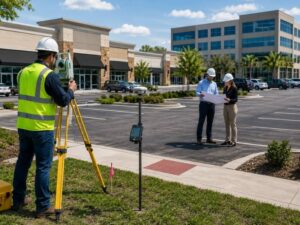
Title problems on commercial sites don’t announce themselves early. They show up at closing, during permit review or after a tenant signs a lease and starts asking questions. An ALTA Land Title Survey is the document that catches those problems before they cost real money. For developers working retail and office deals in Miramar, Florida, getting one ordered early in the process is standard practice for a reason.
Retail and Office Sites Present Unique Survey Challenges
Retail and office properties carry layers of recorded agreements that residential lots rarely have.
Shared parking arrangements, cross-access easements, reciprocal maintenance obligations and private utility agreements all get attached to commercial parcels over time. Each one affects what you can build, how tenants can use the site and what a lender will accept as collateral.
A standard boundary survey won’t capture all of that. It shows the property line and improvements on the ground. It doesn’t tie recorded title documents to the physical site. That gap is exactly where commercial deals run into trouble.
Mixed-use corridors in Miramar, especially along Miramar Parkway and the areas near I-75, often have parcels with histories that include multiple owners, recorded plat conditions and private easement agreements going back decades. Assuming the current condition of the site matches the original plat is a mistake that shows up in due diligence.
An ALTA Land Title Survey Verifies Access, Parking, and Shared Areas
Access and parking are two of the first things a retail or office tenant asks about. An ALTA Land Title Survey answers those questions with legal precision.
The survey shows:
- Where ingress and egress easements run across the parcel
- Whether parking areas sit entirely within the ownership boundary or cross into adjacent parcels
- Shared drive lanes and whether recorded easements support their current use
- Pedestrian access paths and ADA-related site features relative to the boundary
This matters because what looks like a parking lot serving one building may actually straddle two parcels under different ownership. Without a survey that maps recorded easements against the physical site, you don’t know if your tenant has guaranteed legal access to every space they’re counting on.
On office campuses and strip retail centers, shared maintenance obligations also get recorded as easements or covenants. The ALTA survey puts those on paper in a way that engineers, attorneys and lenders can all use.
Recorded Documents May Not Reflect Current Site Conditions
Title commitments pull recorded documents. They don’t send someone out to the site.
A recorded easement from 1987 may describe a drive lane that no longer exists. A utility easement may cover an area where a building addition was put up years later. A shared access agreement may reference a curb cut that got closed when the road was widened.
None of that shows up in a title search alone. An ALTA Land Title Survey takes the recorded documents and maps them against what’s physically on the ground right now. When those two things don’t match, you find out during due diligence instead of after closing.
In Broward County, commercial corridors have been built up, redeveloped and modified across multiple generations. It’s common to find improvements that don’t align with recorded easement descriptions. Lenders and title underwriters expect the survey to catch that. If it doesn’t, they ask for it anyway before issuing a policy.
Why Lenders and Title Companies Often Require This Survey
Most commercial lenders won’t issue financing on retail or office properties without an ALTA survey. Title companies won’t remove certain exceptions from a policy without one either.
The American Land Title Association and the National Society of Professional Surveyors publish the minimum standards for ALTA surveys. The current edition is the 2021 ALTA/NSPS Land Title Survey standards. Lenders and title underwriters use these standards as the baseline for what the survey must cover.
Table A optional items within those standards let lenders request additional information. Common additions for retail and office sites include:
- Flood zone classification per current FEMA maps
- Parking counts and ADA compliance details
- Building setback lines from recorded plats or zoning
- Location of utilities and evidence of easements not in the title commitment
When a lender orders Table A items, they’re asking the surveyor to go beyond the minimum. That extra data is what allows the title company to remove survey exceptions from the policy and give the lender a clean coverage position.
Without the survey, those exceptions stay in the policy. That’s a problem for most commercial financing structures.
Resolving Site Issues Before Leasing, Financing, or Redevelopment
Survey findings don’t have to kill a deal. But finding them early gives you options.
A parking easement that doesn’t cover the current layout can be corrected with a new recorded easement before closing. An encroachment by an adjacent owner can be addressed through a boundary line agreement. A utility easement running through a proposed building addition can be relocated before design gets too far along.
None of those fixes are fast. They involve attorneys, title companies and sometimes neighboring property owners. Starting that process six weeks before closing is a crisis. Starting it during due diligence is normal deal work.
For developers planning redevelopment of existing retail or office sites in Miramar, the ALTA survey also sets the baseline for the new design. Architects need to know where recorded setback lines sit. Engineers need to know where existing easements restrict grading or underground work. Getting that information from the survey at the start of design avoids changes later.
Order the ALTA Land Title Survey when you open the title commitment. Don’t wait for the lender to ask.
Frequently Asked Questions
Can an ALTA Land Title Survey replace a separate topographic survey for a retail redevelopment?
Not always. An ALTA survey documents existing improvements and recorded easements against the boundary. A topographic survey records grades and elevations for drainage and grading design. Some surveyors can combine both into a single field effort, but the two products serve different purposes. Confirm with your civil engineer what base data the design requires before ordering.
What happens if the ALTA survey finds an encroachment from an adjacent property?
The encroachment gets documented on the survey drawing and flagged in the title commitment. From there, the parties typically negotiate a boundary line agreement or an encroachment license. The resolution gets recorded before closing. Title companies won’t insure over an unresolved encroachment on a commercial deal.
How long does an ALTA Land Title Survey take to complete in Broward County?
Most ALTA surveys on retail or office sites take two to four weeks from the time the surveyor receives the title commitment and Table A instructions. Complex sites with multiple recorded easements or large acreage take longer. Ordering early in the due diligence period keeps the survey off the critical path.
Do Table A optional items cost extra on an ALTA survey?
Yes. Each Table A item adds scope to the survey. The total cost depends on which items the lender requires and the complexity of the site. Flood zone determination, parking counts and utility location all add field and research time. Get a quote that specifies which Table A items are included before work starts.
If a prior ALTA survey exists on the site, can it be updated instead of reordered?
A prior ALTA survey can sometimes be recertified if it’s recent enough and site conditions haven’t changed. Most lenders and title underwriters require a survey dated within a specific timeframe, often within 90 days of closing. If improvements, easements or recorded documents have changed since the prior survey, a new survey is required. Check with your title underwriter before assuming a prior survey will be accepted.
For a free land surveying quote, call us at (954) 519-7803 or send us a message by going here.