
Elevation Certificate Mistakes That Can Affect Flood Insurance Pricing
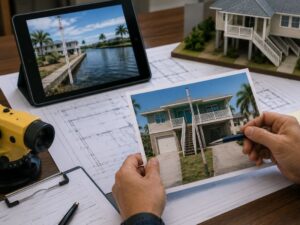
Your flood insurance premium doesn’t come from thin air. It comes from a document called an elevation certificate.
If that document has errors, you pay more than you should. Or your policy gets flagged during renewal. Either way, the problem sits in a certificate most property owners never read.
Broward County has a high number of parcels in FEMA flood zones. A mistake on your certificate costs money until someone fixes it.
Using an Outdated Elevation Certificate After Property Improvements
An elevation certificate records your building’s elevation at a specific point in time. When a building changes, the certificate becomes inaccurate.
Common improvements that invalidate a certificate include:
- Adding fill to raise the lot or pad
- Elevating HVAC or mechanical equipment
- Enclosing a lower floor or crawlspace
- Building an addition that changes the lowest floor elevation
If an outdated certificate is submitted and the insurer catches the error, the policy review stalls. In some cases, coverage gets adjusted retroactively.
In Miramar, many properties have had renovations since their last elevation certification. Order a new certificate any time a project changes the conditions documented in the previous one.
Why Incorrect Building Elevations Can Lead to Higher Insurance Premiums
The NFIP sets flood insurance premiums partly based on how far a building’s lowest floor sits above or below the Base Flood Elevation (BFE). If the certificate records a lower elevation than the building actually has, the insurer prices the policy as if the building is closer to flood level. The property owner pays more for years without knowing the certificate is wrong.
A licensed surveyor performing a certified flood elevation survey verifies the building’s elevations against the applicable flood maps and vertical datum. If the recorded elevation is lower than the building’s actual elevation, the insurer may calculate a higher premium than necessary.
A surveyor who uses the wrong datum, misidentifies the lowest floor, or uses the wrong FIRM panel creates a document that understates the building’s flood protection.
In Miramar, Broward County parcels are covered by multiple FIRM panels. Using the wrong one is a common error for properties near panel boundaries. A PSM who knows Broward County’s flood mapping should verify the correct panel before completing any certificate.
Missing Flood Zone Updates That Change Insurance Requirements
FEMA updates Flood Insurance Rate Maps from time to time. When a new map takes effect, it can change the flood zone for a parcel. A property in Zone X may move into Zone AE. A Zone AE property may shift to a higher risk subzone.
When a map changes and your certificate still references the old zone, your premium is based on the wrong risk level.
Broward County underwent a significant FIRM update in 2021. Properties along the western edge of Miramar have seen zone designation changes in recent cycles. Go to msc.fema.gov to confirm the current FIRM panel and zone for your address before your next renewal.
Common Measurement Errors That Delay Policy Reviews and Renewals
FEMA Form 086-0-33 requires surveyors to record elevations using the North American Vertical Datum of 1988 (NAVD 88). Older certificates sometimes used a different datum called NGVD 29. In Broward County, the difference between the two can be over a foot depending on location. A certificate using NGVD 29 without a conversion note will produce an incorrect comparison against the BFE.
Other errors that delay policy reviews include:
- Wrong identification of the lowest floor
- Missing entries in Section C of the form
- Coordinates that don’t match the building location on the FIRM
- Unsigned certification blocks
Each of these flags the certificate during underwriting. The insurer’s review desk takes over. That can take weeks. Your renewal is on hold until they clear it.
A PSM who regularly prepares elevation certificates in Miramar will know which fields cause problems.
When a New Elevation Certificate Can Lower Your Flood Insurance Costs
Not every error hurts the property owner. Sometimes the certificate works in the wrong direction. It may show a lower floor elevation than the building actually has. Or it may reference a flood zone that is more restrictive than the current FIRM designation. In those cases, a new elevation certificate can reduce premiums.
Check this if any of the following apply:
- The certificate is more than five years old
- Mechanical equipment has been elevated or fill has been added
- A recent FEMA map update changed the flood zone for your parcel
A PSM can review the existing certificate and tell you whether a new survey would produce a better result.
An accurate, current elevation certificate can lower an operating cost without any physical changes to the property.
Frequently Asked Questions
How often should an elevation certificate be updated in Florida?
There is no fixed legal requirement. A new one is needed when a flood map update changes the flood zone or BFE, when improvements alter the building’s elevation data, or when the existing certificate has errors affecting premiums.
Can I use an elevation certificate from the previous property owner?
Yes, if it is current and accurate. An elevation certificate runs with the property. Confirm the flood zone matches the current FIRM, no improvements have changed the elevation data, and the certificate uses NAVD 88.
What is the difference between BFE and the elevation on my certificate?
BFE is the flood elevation level that has a one percent chance of being reached in any given year. The elevation on your certificate is the measured height of specific points on your building. The difference between the two directly affects your premium.
Does FEMA’s Risk Rating 2.0 make elevation certificates less important?
No. Elevation certificates are still required for new NFIP policies in flood zones, for grandfathering, and for LOMA applications. An accurate certificate still affects premium calculations under Risk Rating 2.0.
Who is responsible for errors on an elevation certificate in Florida?
The licensed PSM or registered engineer who signed and sealed the certificate is professionally responsible. Check their license and insurance status at the Florida DBPR website before hiring.