
Boundary Survey Red Flags Before Replacing a Shared Fence
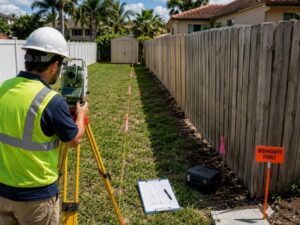
Replacing a shared fence seems simple. Two neighbors agree it’s time. They split the cost. The old fence comes down.
Then someone orders a boundary survey.
What comes back can upend the whole plan. In Miramar, developers and homeowners replacing fences along shared property lines discover problems they had no idea existed. This article walks through the specific red flags a boundary survey uncovers before a single post goes in the ground.
When Both Neighbors Believe the Fence Is Correct but the Survey Says Otherwise
Both neighbors lived with the fence for years. They assumed it was on the property line. Neither questioned it.
A property survey provides accurate property boundary verification by comparing recorded deeds, plats, and physical evidence found on the site. It shows where the legal boundary actually sits, not where someone’s handshake deal put the fence. The fix is to confirm the boundary before work starts and decide together, on paper, where the new fence goes.
In Miramar, Broward County has neighborhoods where original plats from the 1970s and 1980s show slightly different dimensions than the fences that were installed. A fence that looks straight and centered from the street may sit two or three feet off the legal line.
When a survey reveals this, neither neighbor is wrong in the usual sense. The fence was just never placed on the legal line to begin with. Replacing it along the same line means rebuilding an encroachment, which creates a legal record that didn’t exist before. A boundary survey gives both parties the actual numbers before that conversation happens.
Decades Old Fence Agreements That Do Not Match Current Property Records
Older neighborhoods in Miramar sometimes have informal agreements between previous owners. One neighbor agreed to set the fence back two feet. Another agreed to share maintenance. These agreements were sometimes written, sometimes verbal. Either way, they often didn’t get recorded in the property records.
When a property sells, those agreements usually don’t transfer. The new owner doesn’t know about them.
A boundary survey brings the legal property record back into focus. It shows where the boundary actually sits, not where someone’s handshake deal put the fence. The fix is to confirm the boundary before work starts and decide together, on paper, where the new fence goes.
Why Landscaping, Trees, and Retaining Walls Can Hide Boundary Problems
Mature landscaping along a fence line looks permanent. People assume a hedge row or a row of trees marks the boundary because that’s where things grew.
They don’t.
Trees and hedges grow toward light and water. They spread. A hedge planted along a fence line 20 years ago may have shifted several feet in either direction. Retaining walls built along a fence get incorporated into both properties visually. Neighbors use them as reference points.
None of that changes where the legal boundary sits.
In Miramar, where mature tropical landscaping is common along residential fences, boundary surveys regularly find improvements and vegetation extending past the legal line. The survey locates actual corner markers or reconstructs boundary locations from record evidence, giving a precise starting point regardless of where the plants grew.
The Risk of Rebuilding on the Same Fence Line Without Verifying Property Corners
Contractors replace fences. They don’t survey property lines. That’s not their job, and they’ll tell you so.
When a fence contractor replaces a fence, they follow the existing line. It’s faster and nobody questions it. If the old fence was off the legal boundary, the new one is too. Now there’s a new fence, new posts, and a new record of where the improvement sits.
In Florida, boundary by acquiescence is a legal doctrine. When two neighbors treat a line as the boundary over time, courts sometimes recognize that line as the legal boundary even if it doesn’t match the recorded description. A boundary survey before replacement documents what the legal line actually is. That documentation matters if a dispute arises later.
The cost of a boundary survey in Broward County for a standard residential parcel runs between $400 and $1,200 depending on lot size and complexity. That cost is almost always less than resolving a boundary dispute after the new fence is built.
How a New Fence Can Reveal an Existing Encroachment
Sometimes the problem isn’t the fence you’re replacing. It’s what’s near it.
A pool deck that extended too close to the boundary line. A storage shed that sits partially on the neighbor’s property. A concrete pad that crosses the legal line by 18 inches. These conditions existed before the fence replacement project started. Nobody noticed because the fence was there and nobody was looking closely.
When a boundary survey is ordered for a fence replacement in Miramar, the surveyor documents existing conditions. If something is encroaching, it shows up on the survey.
This is useful even when the finding is inconvenient. Knowing about an encroachment before a new fence goes in gives both parties time to resolve it. Options include a recorded easement agreement, a lot line adjustment, or a hold-harmless arrangement between neighbors. Acting before the new fence is built is always less expensive than addressing it afterward.
Frequently Asked Questions
Does Florida law require a boundary survey before replacing a fence?
Florida law doesn’t require one for every fence replacement. Miramar’s permit process typically requires survey data showing the property line and proposed fence location. A boundary survey also protects both neighbors from rebuilding on an incorrect line.
What happens if my neighbor refuses to agree to a boundary survey before fence replacement?
You can order a boundary survey on your own property without your neighbor’s agreement. It establishes where the legal line sits from your side. You can then place your fence based on that information.
How old does a fence have to be before it becomes a legal boundary in Florida?
Florida doesn’t set a fixed time period for boundary by acquiescence. Courts look at whether both neighbors treated the fence as the boundary and for how long. A boundary survey documents the recorded legal line before that question arises.
Can I place a new fence inside my property line to avoid a boundary dispute?
Yes. Setting a fence one to two feet inside the legal boundary is a common approach in older neighborhoods. A boundary survey tells you exactly where the legal line is so you know how far inside it you’re placing the fence.
What should I do if a boundary survey finds a discrepancy between the fence and the property line?
Get the finding in writing and share it with your neighbor before work begins. Options include adjusting the fence to the legal line, recording a boundary line agreement, or having an attorney review whether an existing claim applies.