
Why Commercial Buyers Should Review Easements Before Site Plan Design
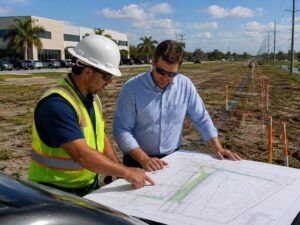
Commercial buyers often get a title commitment and think they know what they’re buying.
They don’t.
A title commitment lists recorded documents. It does not show where those documents sit on the ground. A boundary survey does that. Without one, a site plan can be drawn around an easement nobody mapped. Then the engineer has to start over.
Hidden Easements That Can Limit Where Buildings, Parking, and Utilities Are Placed
Not all easements are easy to spot. Some were recorded decades ago. Others were added by utility companies and only show up as Schedule B exceptions in a title commitment.
A boundary survey maps recorded easements onto the property. It shows where each one runs, how wide it is, and what it prohibits.
In Miramar, commercial parcels often carry:
- FPL power line easements that cross parking areas or building footprints
- Broward County drainage easements that ban permanent structures
- SFWMD canal setback easements near western Miramar’s drainage network
- Cross-access easements that require shared vehicle access with adjacent lots
Each one limits where a building can go. Finding out about them after a site plan is drawn costs a lot of money.
Why Recorded Documents Do Not Always Match Existing Site Conditions
The title commitment shows what’s recorded. The boundary survey shows what’s on the ground. These two things don’t always match.
A drainage easement recorded in 1978 may have moved when a canal was widened. The new location isn’t always in the recorded documents. A boundary survey shows where the easement boundary sits today.
In Miramar, older commercial parcels have utility infrastructure that was built before current recording rules. Power poles, underground cables, and drainage structures sometimes sit in spots that differ from what the old plat shows.
A commercial land survey, combined with a utility locate, gives the civil engineer an accurate picture of existing site conditions. That lowers the risk of a stop-work order during construction.
Utility Access Rights That Can Affect Future Property Improvements
Utility easements give service providers the right to access and fix their infrastructure on private land. That right stays with the land. It does not go away when the property sells.
For commercial buyers in Miramar, utility easements can affect:
- Building setbacks near FPL power lines
- Paving limits inside drainage easements
- Landscaping near underground utility lines
- Access roads for utility trucks that affect parking layout
A utility company can make you remove any structure built inside their easement. You pay for that removal. A boundary survey shows easement locations before anything gets built in the wrong place.
How Easements Influence Site Layout Before Engineering Begins
Easements don’t just affect where structures can’t go. They affect the whole site layout.
A drainage easement cutting across a parcel can split a parking lot in two. An FPL easement along the rear property line can push the building closer to the street. That can conflict with front setback rules. A cross-access easement may force a driveway location that doesn’t work with the planned circulation.
A site plan drawn without easement data gets sent back for revisions. Sometimes more than once.
Broward County requires that site plan submissions show all recorded easements. A plan submitted without them gets a deficiency comment. That adds weeks to the permit timeline. A boundary survey done before the civil engineer starts prevents all of that.
Identifying Potential Development Constraints Before Closing the Purchase
Find easement problems before closing. Not after.
Easements go with the deed. A drainage easement that cuts through the buildable area doesn’t go away because the buyer didn’t know about it.
During due diligence, a boundary survey shows easements and their exact locations on the parcel. If they limit what the buyer planned to build, that becomes a negotiating point before closing.
Common findings in Miramar commercial deals:
- Drainage easements that shrink the net buildable area
- Utility easements that shift the building footprint from the preferred spot
- Canal setbacks that reduce lot coverage on waterfront parcels
- Cross-access obligations that affect parking layout
Each one affects whether the project is feasible.
Frequently Asked Questions
What is the difference between a title search and a boundary survey for easement review?
A title search lists easements by document number. It does not show where they sit on the ground. A boundary survey plots each easement on a scaled map of the parcel. A title search finds what’s recorded. A boundary survey shows where it is.
Can an easement stop a building from being built on a Miramar commercial parcel?
Yes. An easement that runs through a building footprint blocks construction in that area. A boundary survey done before site plan design shows which parts of the parcel are encumbered. It also shows how much buildable area is left.
Do cross-access easements show up on a boundary survey?
Yes, if they are recorded. A boundary survey shows cross-access easements plotted to scale with their location and width. If one requires a specific driveway location, that will show up before the civil engineer begins layout.
What should a commercial buyer do if a boundary survey finds an unrecorded easement?
An unrecorded easement can still be legally binding under Florida law. Have a real estate attorney look at it before closing. Options include asking for a price reduction, requiring the seller to fix it, or walking away if the project won’t work.
How early in due diligence should a boundary survey be ordered for a Miramar commercial deal?
Order it as early as you can. A boundary survey for a commercial parcel in Broward County takes about two to four weeks. Starting early gives you time to review the findings and negotiate with the seller if something affects the value.